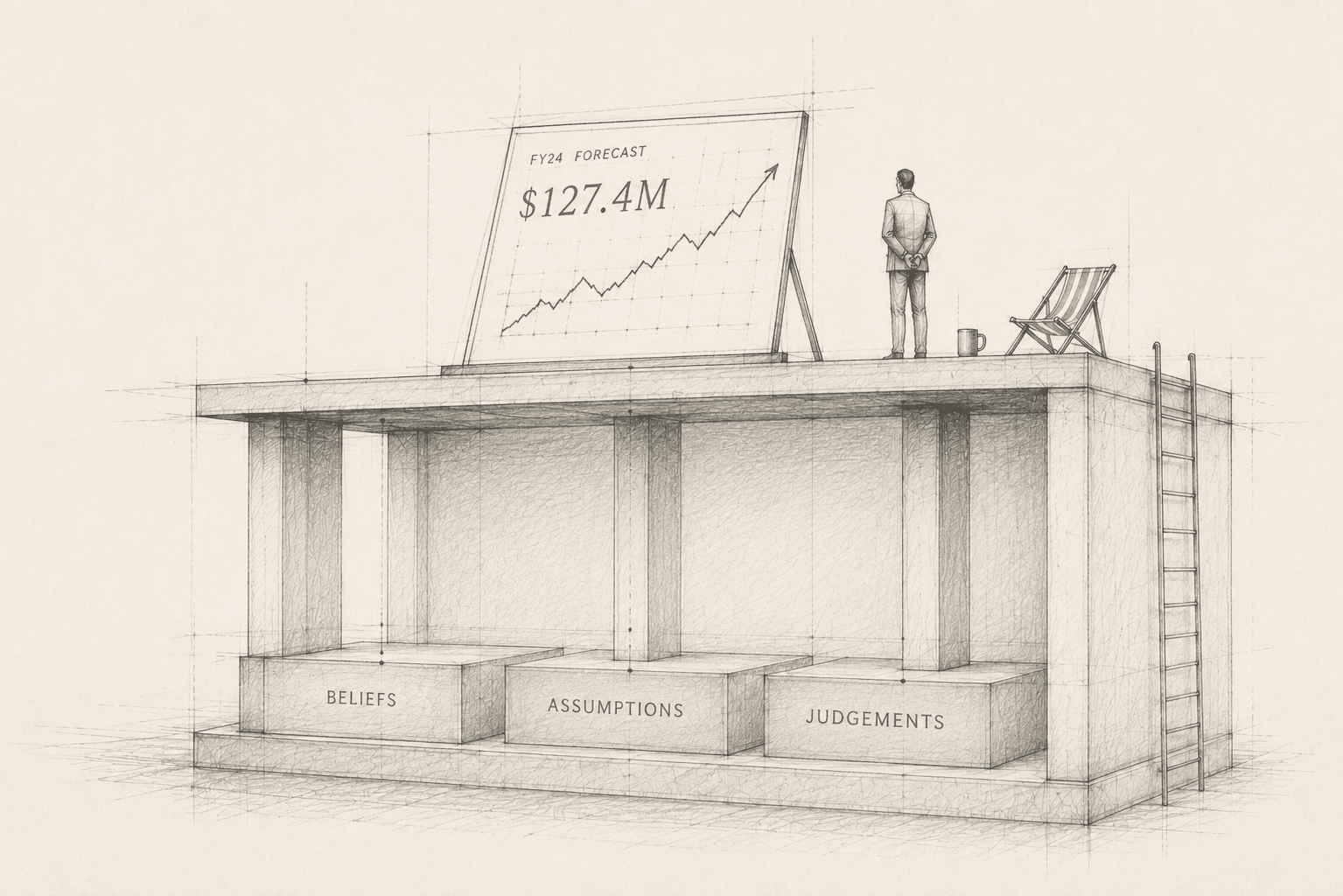
Most organizations treat the revenue forecast as a number. It is reviewed, adjusted, challenged, and eventually reported.
But the number itself is only the visible surface.
Beneath it sits an operating belief system: assumptions about buyer behavior, sales execution, pipeline quality, deal progression, leadership judgment, and the reliability of the information moving through the organization.
When leaders say they trust the forecast, they are not merely expressing confidence in a spreadsheet. They are expressing confidence in the system that produced it.
The forecast reveals what the organization believes
Every forecast contains embedded judgments.
Which opportunities are real? Which buyers are committed? Which delays are temporary? Which risks are manageable? Which sellers truly understand their deals?
These judgments are rarely neutral. They are shaped by incentives, habits, experience, pressure, and the quality of the operating conversations taking place throughout the business.
A forecast therefore becomes a record of collective belief. It reveals what the organization accepts as evidence, what it discounts, and where optimism is allowed to substitute for clarity.
Forecast accuracy is a system outcome
Inaccurate forecasts are often treated as individual performance problems. A seller was too optimistic. A manager failed to inspect the deal. An executive applied the wrong judgment.
Sometimes that is true.
More often, the error is systemic. The organization has not established a shared definition of evidence, risk, buyer commitment, or meaningful commercial progress.
When those definitions remain vague, each person creates a private interpretation. The forecast becomes an aggregation of different mental models rather than a coherent view of the business.
The spreadsheet may be shared. The underlying logic is not.
The deeper question
The most useful forecast conversation is not, “Will we hit the number?”
It is, “What must we believe about the business for this number to be true?”
That question moves the discussion beneath the visible result. It exposes assumptions, dependencies, weak signals, and gaps in judgment before they become public misses.
It also changes the purpose of forecast inspection. The goal is no longer to defend a number. It is to examine the quality of the beliefs supporting it.
A more reliable forecast does not begin with more pressure.
It begins with greater clarity about how the organization knows what it claims to know.